
South African exporters are facing rising uncertainty as global trade rules shift, tariff regimes become more complex and infrastructure constraints continue to limit market access. Speaking at a recent Exporters Western Cape (EWC) event in Cape Town, industry experts highlighted the increasing complexity of global trade and policy.
Linda Bird-Duxbury, Director at International Trade Consultants, said uncertainty around the African Growth and Opportunity Act (AGOA) and recent tariff actions by the United States had created a highly fluid trading environment. “The landscape is extremely difficult to interpret at present,” she said, noting that several tariff measures had been implemented without fully following required legal processes and were now subject to review.
She stressed that exporters needed to distinguish between trade preference programmes such as AGOA and separate trade remedies, including anti-dumping duties, countervailing duties and national security-related tariffs.
“Eligibility does not automatically translate into duty-free access,” she said, adding that compliance with tariff classifications, rules of origin and evolving regulatory requirements remained critical.
Bird-Duxbury warned against relying too heavily on a single export market, saying diversification is key to managing geopolitical and policy risk. Against this backdrop, businesses are also grappling with how to position themselves in international markets.
Delivering the keynote address, Nick Dreyer, founder and CEO of Made in RSA, said South African businesses were facing new pressures in international markets as global trade conditions change, with traditional export models no longer working for many smaller companies.
Dreyer, who is also the founder of South African footwear brand Veldskoen, said the country had no shortage of globally competitive products and ideas, but lacked the commercial infrastructure needed to access international markets.
“The truth is, our country is bursting with world-class talent – products, brands and ideas that can hold their own anywhere in the world. What’s missing isn’t quality; it’s access,” he said.
Drawing on his experience building Veldskoen into a global brand present in 35 countries and generating turnover of around R100 million, Dreyer said what appeared to be success was not sustainable. “On the brand side, we got it right, but the business itself wasn’t scalable,” he said.
He explained that the traditional export model, which relies on placing inventory in multiple international markets, creates significant financial pressure by tying up capital and adding layers of operational complexity.
“Businesses are required to move stock across multiple geographies, often committing capital upfront without certainty of demand, while navigating complex logistics, warehousing and distribution costs – costs that stack up at every stage of the process,” he said.
Dreyer pointed to the emergence of Made in RSA, a digitally enabled model that allows businesses to sell directly to global consumers without maintaining offshore stock, reducing both capital exposure and time-to-market.
Exporters Western Cape CEO Terry Gale said that while global opportunities for South African exporters were increasing, the ability to unlock them would depend on stronger alignment between trade policy, business strategy and infrastructure.
“Exporters need to remain agile, diversify their markets and adapt quickly to stay competitive in a fast-changing global environment,” he said.
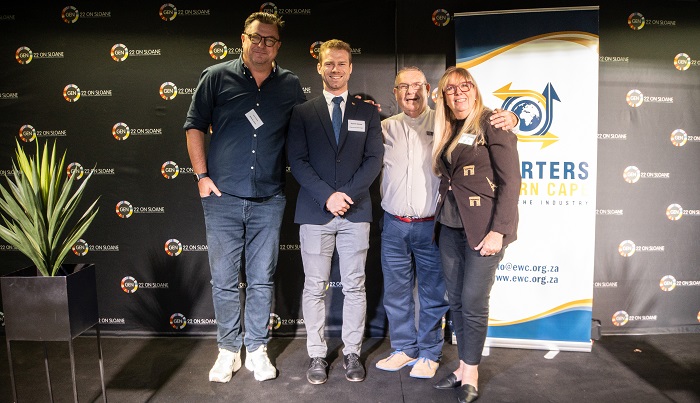
Pic left to right: Nick Dreyer, Founder and CEO of Made in RSA; Gareth Ramsey, Senior Engineer at Automotion; Terry Gale, CEO of Exporters Western Cape; and Linda Bird-Duxbury, Director at International Trade Consultants.