
Kaleido Logistics has announced the integration of International Freight Services South Africa into its global network, adding to their continued expansion across the African continent. Following the integration, IFS South Africa will operate under the name Kaleido Logistics South Africa.
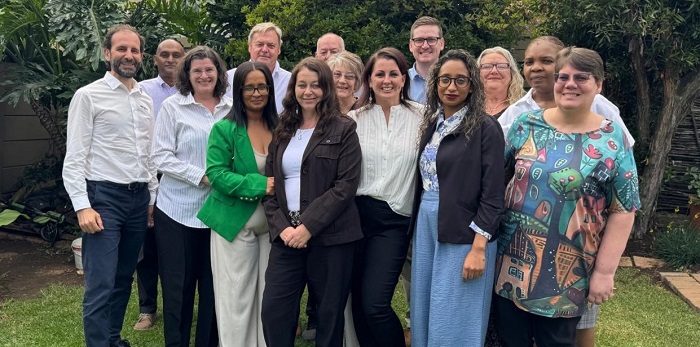 Xoán Martínez -Kaleido Logistics CEO - & Wayne Gunning -Founder and Director of IFS - with IFS team
This integration is aligned with Kaleido’s long-term strategy to strengthen its presence along key African trade corridors, where the company already operates through its own companies in Angola, Namibia, and Mozambique. Through continuous investment in logistics hubs, specialized equipment and, above all, local teams with deep knowledge of each market and its logistics dynamics, Kaleido Logistics has built a strong operational platform across Southern Africa. The addition of South Africa further enhances the Group’s ability to deliver integrated, efficient, and reliable logistics solutions in highly complex environments.
This move reflects Kaleido’s broader strategy to strengthen and develop logistics corridors across Southern Africa. The company currently manages the transport and logistics of raw materials, as well as a growing volume of processed goods and project cargo, not only within the countries where it operates, but also across regional trade flows linked to markets such as the Democratic Republic of the Congo, Zambia, Zimbabwe, Botswana, and Madagascar. These operations are supported through key ports including Luanda, Lobito, Walvis Bay, Durban, Beira, and Nacala, while also supporting the growing trade flows between SADC member countries.
“This integration represents a natural step in our growth strategy in Africa,” said Xoán Martínez, CEO of Kaleido. “By combining strong local expertise with Kaleido’s global network, we are enhancing our capabilities and creating new opportunities to support our clients across the region.”
Continuity for IFS clients and services will remain a top priority. Operations will continue to be managed by the same local teams, ensuring consistency in service delivery, relationships, and operational excellence.
The integration is expected to deliver expanded service capabilities, improved cross-border coordination, and greater efficiency in managing logistics flows along major African corridors.