
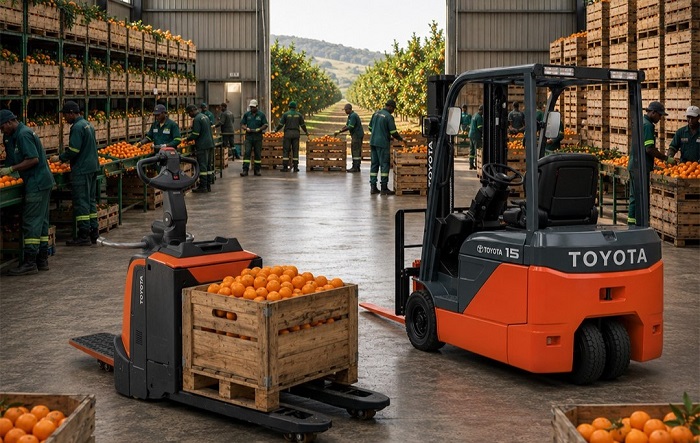
During the Eastern Cape’s busy mid-year citrus export season, when producers require additional equipment for harvesting, packing and loading operations over a defined period rather than throughout the year, forklift rental is a practical solution for companies that need additional material handling capacity without the financial commitment of expanding their permanent fleet.
Charl Snygans - Regional Sales Manager for Toyota Material Handling says seasonal demand is the primary driver of short-term forklift rentals in the Eastern Cape, with the agricultural sector accounting for approximately 80% to 85% of this demand. "For many citrus operations, activity ramps up from April or May through to September. During those six or seven months, they need additional forklifts to keep production moving, but once the season ends, that demand falls away."
The result is a significant increase in short-term rental demand, particularly for electric counterbalance and diesel forklifts that support high-volume agricultural operations.
Rather than purchasing equipment that may only be used for part of the year, rental allows businesses to align fleet size with operational demand while keeping capital available for other priorities.
From a financial perspective, as the equipment is not owned by the customer, there is no asset depreciation to account for, and rental costs can be treated as an operating expense rather than tying up capital in machinery that is underutilised for much of the year.
For businesses with predictable seasonal demand, structured rental agreements can provide even greater flexibility. Long-term seasonal rental agreements, for example, allow customers to secure equipment over several years while only paying during the months it is actually required.
While agriculture dominates short-term rental activity in the Eastern Cape, the warehousing and logistics sector typically follows a different model.
Snygans says warehouse operations generally maintain more consistent production levels throughout the year, making long-term rental agreements a preferred option. “These operations usually rely on a combination of electric counterbalance forklifts, reach trucks and electric pallet trucks to manage inbound and outbound loading, stock replenishment and staging in distribution centres.”
Across both sectors, however, purchasing decisions are increasingly being driven by operating costs rather than acquisition price alone.
"Customers are asking a different question today," says Snygans. "Instead of focusing only on the monthly rental or purchase price, they're looking at cost per hour, equipment utilisation and the impact that downtime has on their business."
This growing emphasis on operational efficiency is also accelerating interest in electric forklifts. “While about 60% of our business is diesel forklifts, interest is growing in electric forklifts, especially considering their lower operating costs and standard technologies that help businesses improve fleet efficiency and workplace safety.”
Notably, telematics systems, such as Toyota’s I_Site, provide detailed information on equipment utilisation, allowing fleet managers to identify underused assets, optimise deployment and improve overall productivity. Safety technologies, including operator presence systems and pedestrian detection solutions, further support safer, more efficient operations.
Equally important is the support that accompanies the equipment. Reliable aftermarket support plays a critical role in keeping rental fleets productive, particularly during peak operational periods when unplanned downtime can disrupt production schedules.
“The real cost to a business is not always the rental rate, it's downtime. If equipment isn't operational when the business needs it, the impact extends well beyond the forklift or reach truck itself," says Snygans.
Snygans says durability is another key consideration when selecting rental equipment, particularly in demanding, time-sensitive environments such as agriculture and logistics.
“A durable machine reduces interruptions, improves uptime and ultimately delivers better value throughout its working life. Strong chassis design, durable axles, quality mast assemblies and robust components all contribute to reliable performance in intensive applications," he adds.
Rental also provides businesses with valuable flexibility in uncertain economic times. Companies experiencing changes in production volumes or customer demand can adjust their fleet requirements more easily than if they had invested in additional owned equipment.
"When businesses don't know exactly what the next few months hold, rental allows them to respond quickly. It gives them the equipment they need to maintain productivity, without locking them into unnecessary long-term commitments,” concludes Snygans.