

For years, the debate around electric vehicles (EVs) in South Africa has focused on whether the technology works. That question has largely been answered. The real question now is this: why would fleet operators continue to rely on a cost base in their business that is fundamentally unpredictable?
Now more than ever, the economics on the diesel side have become increasingly unstable. Fuel prices are no longer a predictable input. They are a moving target, driven by global events that have nothing to do with your business, your routes, or your customers.
Today, fleet economics start with the cost per kilometre. We look at how far vehicles travel each month, what they carry, where they operate, and what it costs to keep them on the road. At lower diesel prices, EVs required higher usage to make sense. A few years ago, you needed to be running relatively high monthly kilometres before the numbers started to work in your favour. That is where much of the early hesitation to migrate to EVs came from.
Reaching the turning point
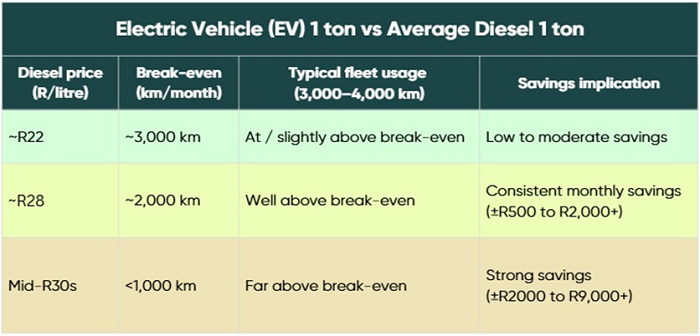
But as diesel prices continue to rise, that break-even point drops quickly. At around R22 per litre (roughly where diesel has sat during more stable periods), an electric one-ton equivalent typically begins to compete once you operate at approximately 3,000 kilometres per month. That already covers a significant portion of urban delivery routes.
When the diesel price is moved to R28 per litre, the picture changes significantly. The same vehicle starts to make financial sense at closer to 2,000 kilometres per month. At that point, you are moving from good use cases to mainstream fleet operations. A typical urban vehicle running 3,000–4,000 km per month is now operating well beyond break-even, resulting in consistent monthly savings of thousands of rand per vehicle.
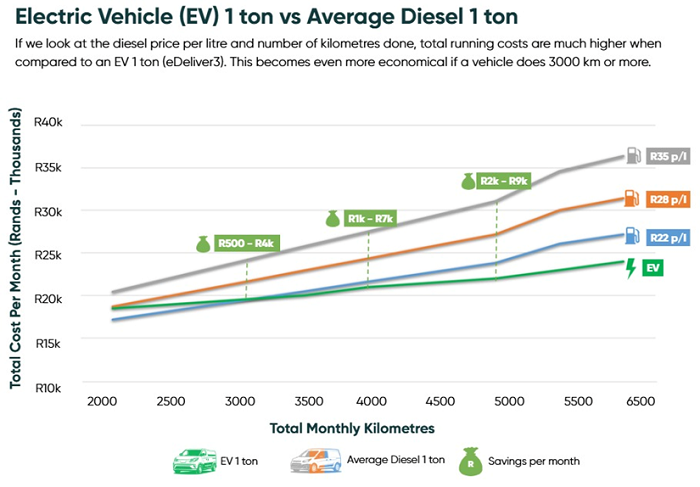
Push diesel into the mid-R30s, which is well within reach in the current environment, and the economics change again. The break-even point drops to well below 1,000 kilometres per month. At that level, almost any consistently used commercial vehicle starts to make sense to electrify. At this level, nearly all actively used fleet vehicles generate a cost advantage. Even low-utilisation vehicles begin to deliver meaningful savings, while standard routes see those savings widen significantly.
What stands out is the compounding effect: higher diesel prices do not just improve the EV case incrementally, they expand the savings pool across a larger portion of the fleet, while increasing the per-vehicle benefit.
It is not that EVs have become cheaper. What has changed is the sensitivity of diesel costs. As fuel prices rise, the number of kilometres you need to justify an EV falls sharply. The higher the volatility, the faster that crossover happens.
On a typical urban route running around 4,000 kilometres per month, the cost difference becomes difficult to ignore. At current diesel levels, fleet owners can save several thousand rand per vehicle per month. If fuel prices continue to increase, those savings become even more compelling.
Decoupling risk
With diesel fleets, costs are tied directly to global oil prices and exchange rates. With electric fleets, a larger share of costs becomes predictable, such as energy, maintenance, and performance, which can be managed within a narrower range.
Even when electricity prices increase, the impact is significantly less volatile than that of fuel. Electricity makes up a smaller portion of the total cost equation, and its movements are more gradual. That means you can forecast your fleet costs with far greater confidence.
This does not mean EV adoption is without challenges. Infrastructure availability, upfront capital costs, and operational adjustments remain real considerations. However, these are increasingly manageable and, importantly, predictable unlike fuel price volatility.
Logistics businesses are already running under tight margins. You are managing fuel, labour, maintenance, and delivery expectations in an environment that is not getting any easier. The question is not whether you can afford to experiment with new technology but whether you can afford to leave such a major cost driver exposed to external forces.
EVs offer a way to decouple from that. While they do not eliminate cost, they change the nature of it. They shift those costs from reactive and externally driven to planned and internally managed. That is a very different proposition from what we were discussing just five years ago.
Back then, the risk was whether EVs would perform as expected. For fleet operators, the risk equation has flipped. The question is no longer whether EVs are viable, but whether diesel dependency is sustainable.

Paul Plummer, Chief Commercial Officer, Everlectric